

A Comprehensive Analysis of How Price Erosion Occurs and What Brands Can Do to Protect Their Margins
As an IP attorney and brand protection expert who has worked with hundreds of consumer brands across Amazon, Walmart, eBay, and Google Shopping, I’ve witnessed firsthand how price erosion can transform a thriving business into a struggling one. What starts as a few unauthorized sellers “killing them on price” quickly spirals into a marketplace race to the bottom that destroys brand value, retailer relationships, and profit margins.
Through my work with Sigil and my legal experience advising brands on intellectual property policies, I’ve seen the devastating impact when brands don’t understand the different types of price erosion—or more importantly, how to combat them systematically.
Understanding the Price Erosion Landscape
This is not an academic article. This is intended to be practical and useful for brands looking to grow and win in today’s omnichannel landscape. With that in mind, price erosion isn’t a single phenomenon. It’s a complex ecosystem of pressures that chip away at your pricing power through different mechanisms. In my experience working with brands from startup to Fortune 500 level, I’ve identified three distinct mechanisms of price erosion that each require targeted approaches.
3P Seller Driven Erosion
The most common complaint I hear from brands sounds like this: “Amazon resellers are killing us on price,” or “3P sellers are undercutting us everywhere.” This represents what I call the 3P Seller Driven Erosion—where sellers obtain authentic products through unauthorized channels and undercut your minimum advertised price (MAP) policies to win the Buy Box.
Owning the Buy Box is critical, especially if brands are using advertisements to drive growth (which brands pretty much have to do today) or are driving traffic to Amazon or Walmart from off-platform. It’s often worth it to lower price and take the Buy Box back, and that’s exactly what many Brands do.
Unfortunately, the third-party resellers have no need to maintain a relationship with the brand and often acquire the inventory at extreme discounts through gray market channels, liquidations sales, or leaked distribution networks. As a result, they have much more room to drop down on price, and will undercut the brand again to gain back sales. I have seen this back and forth drop a brand’s flagship product by 41%, functionally eliminating any profit margins once you account for the platform fees.
Algorithm Driven Erosion
Amazon’s pricing algorithm represents another category of price erosion that many brands don’t fully understand. The platform continuously scrapes the internet for lower prices, and when Amazon acts as a first-party seller, it will automatically lower prices to match competitors. We call this Algorithm-Driven Erosion.
To understand Amazon’s price matching algorithm, take a look at my other article that discusses it more in depth, How Brands Lose the Amazon Buy Box and Walmart Featured Offer.
Important to understand here is that price drops off the marketplace platforms can (and do!) still drop your marketplace channel pricing. I have worked with brands who experienced this in the extreme, where the algorithm-driven price erosion caused the product to “CRaP out”. CRaP means “Cannot Realize any Profit” and is a status used by Amazon for products that are not longer profitable, leading to Amazon’s vendor team to stop buying the product, delisting it, or removing purchase orders. Obviously, you don’t want your products on Amazon’s CRaP list.
Repricing Driven Erosion
We now live in an era where repricing tools and technology are affordable and widely available. Most online retailers now employ repricing technology in order to maintain competitive pricing, and to capture profitability if market prices lift. Unfortunately, this works against brands when 3P Seller or Algorithm Driven erosion triggers.
The main issue here is identifying the first mover. In most cases, major retailers are selling as authorized providers of a brand, making them subject to brands’ MAP policies, if they have them. But the retailers often have no idea that the repricing has occurred since it’s running automatically, and if they get caught, they will truthfully be able to say that they were simply reacting to someone else dropping price. This is why some MAP tools boast being able to identify the first mover, but of course, that doesn’t matter much if the first mover was an unauthorized seller or someone with the clout of Amazon. Amazon notoriously refuses to abide by MAP policies. (Brands beware).
Retailer Driven Erosion
This occurs when your brick-and-mortar retailers demand price reductions or compensation from the brands for having to compete with the reduced and eroded prices of your products online. In fairness, this is almost always a reaction to the other types of erosion, but the impact on the brand is different. This affects bottom-line profits, not top-line revenues, by demanding price protection payments.
Alternatively, and frankly in my experience, more commonly, the erosion here is a silent, quiet quitting of your brand from the retailer. They refuse to expand to more doors, they won’t take your new SKUs, or they’ll roll back your listing. Of course, I have seen extreme examples with national retailers making very loud complaints and threatening to drop one sporting goods brand entirely–the brand rescued the relationship but it cost them a pretty penny on repayments.
How Price Erosion Impacts Your Brand’s Profits
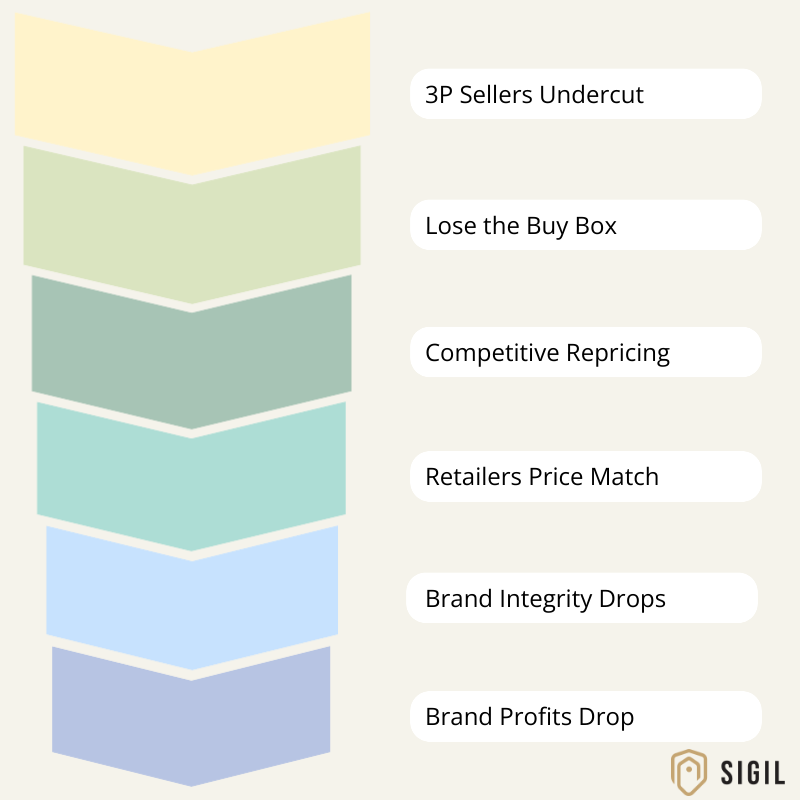
The Root Causes Behind Consumer Brand Price Erosion
Wide, Uncontrolled Distribution Networks
Through my work with global brands, I’ve learned that price erosion is most prevalent among companies with large, decentralized distribution networks spanning multiple regions. When numerous distributors and retailers make independent pricing decisions without centralized control, it creates natural vulnerabilities.
Supply Chain Leakage
One of the most insidious causes of price erosion is unauthorized diversion within your own supply chain. Authorized distributors sometimes sell excess inventory to unauthorized channels, creating the very problem brands are trying to prevent.
During my investigations, I regularly uncover invoice trails showing authorized distributors supplying inventory to known unauthorized sellers. The challenge is that these distributors often face their own margin pressures and turn to gray market sales to move excess stock, inadvertently undermining the brand’s pricing strategy.
Insufficient Legal Framework
Many brands lack the legal infrastructure to combat price erosion effectively. Without proper policies, trademark protections, or enforceable agreements, brands have limited recourse when sellers undercut their pricing.
I’ve seen this repeatedly: brands discover widespread price erosion but realize they have no legal standing to address it because they never established the necessary contractual relationships or intellectual property protections.
The Compound Impact on Brand Value
When it comes to price erosion, the impacts to brand integrity are just as important for a brand to consider as the economic consequences. I have seen this play out first hand.
Customer Expectation Reset
Once customers become accustomed to discounted prices, they resist future price increases and expect lower prices as the norm. This psychological shift can permanently damage a brand’s ability to command premium pricing, even after unauthorized sellers are removed.
This is particularly problematic for companies building premium or luxury brands. You need to support your price structure with higher perceived value, but when your pricing is consistently undercut, your brand just can’t support its luxury position with customers.
Retailer Relationship Erosion
When authorized retailers cannot achieve promised margins due to price erosion, they often demand compensation, reduce marketing support, or ultimately drop the brand in favor of competitors with more disciplined pricing.
Maintaining relationships with retailers is a long term exercise. Many category buyers at major retailers are the gatekeepers to a brand’s successful expansion. If they take a chance on you, and then they think you blow it by failing to deal with price erosion, you’ll be out of luck for years to come. Usually you’ll have to wait for a new buyer to take over.
The False Economy of Inaction
I regularly encounter brands that delay addressing price erosion due to cost concerns, but this represents a fundamental misunderstanding of the economics involved. The cost of comprehensive brand protection is typically a fraction of the revenue loss from unchecked price erosion.
Consider a mid-size consumer brand losing $500,000 annually to price erosion. A comprehensive brand protection program costing $100,000 annually that recovers even 60% of that loss generates a 3:1 ROI in the first year, with compounding benefits as brand equity is preserved and retailer relationships strengthened.
If you want to learn more about the best programs and technology out there to fight price erosion, DM me on Linkedin. Obviously I’m going to be biased toward Sigil (and you should definitely look at our case studies), but I’m happy to give you an honest viewpoint on other strategies and options as well.
Looking Forward: The Evolution of Price Protection
The landscape continues evolving rapidly. AI technology is making enforcement more efficient and cost-effective, while new marketplace policies create both opportunities and challenges for brands. The key is developing flexible, scalable approaches that can adapt to changing circumstances while maintaining focus on core principles.
Success requires recognizing that price erosion isn’t just a tactical problem—it’s a strategic threat that demands executive attention, adequate resources, and systematic execution. Brands that treat it as such consistently outperform those that attempt piecemeal solutions or ignore the problem entirely.
The stakes are too high and the solutions too accessible for any serious brand to accept price erosion as an inevitable cost of doing business. With proper strategy, technology, and execution, brands can maintain pricing discipline while growing their omnichannel presence.
The question isn’t whether you can afford to invest in comprehensive brand protection—it’s whether you can afford not to.